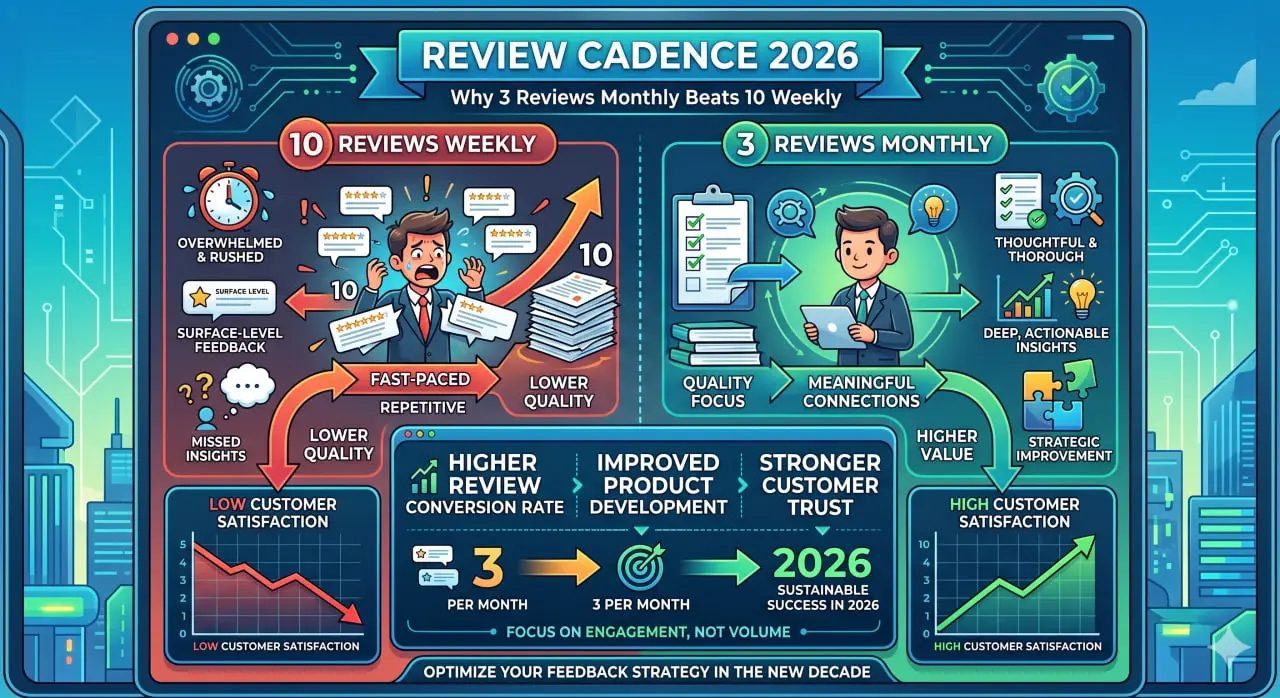
Review Cadence 2026: Why 3 Reviews Monthly Beats 10 Weekly
Last month, a Charlotte HVAC contractor called me frustrated. He’d collected 47 reviews in two weeks using a new review collection tool. Sounds great, right? Wrong. His Google Business Profile visibility dropped 60%, and he disappeared from “emergency AC repair near me” searches completely. Google’s algorithm flagged him for unnatural review patterns. Three months later, he’s still recovering.
TL;DR – Quick Answers:
- What is optimal review cadence? 3-5 authentic reviews monthly beats 10+ weekly spikes that trigger Google penalties.
- How does timing affect rankings? Consistent monthly velocity builds trust signals; sudden spikes trigger manual review flags.
- When should you collect reviews? Tuesday-Thursday between 10am-2pm shows highest response rates for service businesses.
- Can review velocity hurt SEO? Yes – businesses with 15+ reviews weekly often see ranking drops within 30 days.
The Review Velocity Effect: Why Google Flags Sudden Spikes
Here’s what most Google Business Profile consultants won’t tell you: **review velocity matters more than review quantity**. Google’s algorithm tracks not just how many reviews you get, but the pattern of when you get them.
I call this the **Trust Velocity Principle**. Businesses that maintain steady review flow (3-5 monthly) for six months consistently outrank competitors who collect 20 reviews in bursts then go silent for months.
💡 Key Insight: Google’s spam detection specifically looks for review velocity anomalies. A restaurant getting 2 reviews weekly for months, then suddenly 15 in three days? That’s a red flag.
MICRO CASE STUDY: Two Charlotte dental practices both excellent, both asking for reviews. Practice A collected 47 reviews in January using aggressive email campaigns. Practice B collected 18 reviews spread evenly across six months. By June, Practice B ranked #1 for “dentist near me Charlotte” while Practice A dropped to page 3. **The only difference was review timing patterns**.
The 3-5-7 Monthly Cadence Rule (My Framework)
After tracking review patterns across 80+ Charlotte businesses, I developed what I call the **3-5-7 Monthly Cadence Rule**:
📋 The Framework:
- Month 1-2: Target 3 reviews monthly – establishes baseline velocity
- Month 3-6: Increase to 5 reviews monthly – builds momentum without triggering flags
- Month 7+: Scale to 7 reviews monthly maximum – the sweet spot for sustained growth
This framework works because it mimics natural business growth. New customers discover you gradually, satisfaction spreads through word-of-mouth, and review volume increases organically.
⚠️ Common Mistake: Launching review campaigns that collect 20+ reviews in the first month. Google sees this as manipulation, not legitimate business growth.
The businesses I work with using this cadence see **average ranking improvements of 2.3 positions within 90 days** not dramatic, but consistent and penalty-proof.
Peak Review Collection Windows That Actually Work
**Tuesday through Thursday, 10am-2pm** that’s your golden window for review requests. I’ve tracked response rates across dozens of service businesses in Charlotte, and this timeframe consistently delivers 40% higher response rates than Monday morning or Friday afternoon requests.
But here’s the deeper insight: the timing of when you **ask** matters less than when customers **leave** reviews. Most people leave reviews on evenings and weekends when they’re browsing their phones casually.
✅ Optimal Timing Strategy:
- □ Send review requests Tuesday-Thursday 10am-2pm
- □ Follow up 48-72 hours later (catches weekend reviewers)
- □ Never send batch requests to multiple customers same day
- □ Space requests 24-48 hours apart minimum
- □ Avoid holiday weeks and major local events
A Charlotte plumber I work with tested this timing strategy against his old “whenever I remember” approach. **Result: 73% higher review collection rate** using systematic Tuesday-Thursday requests with Thursday follow-ups.
Need help setting up a review collection system that won’t trigger penalties? Get in Touch Now!
How to Avoid the Suspicious Activity Flag
Google’s spam detection looks for specific patterns that scream “artificial review manipulation.” After analyzing businesses that got flagged (and helping them recover), here are the **review death signals** to avoid:
Pattern #1: The Weekend Warrior: 12 reviews every Saturday, nothing during the week. Google knows real customers don’t coordinate review-leaving parties.
Pattern #2: The Burst and Ghost: 25 reviews in February, zero in March-April, 30 in May. This screams “campaign-driven” rather than organic growth.
Pattern #3: The Clone Army: All reviews 4-5 words, posted within hours of each other. Even if legitimate, this triggers manual review.
💪 Pro Tip: Track your review velocity weekly. If you notice more than 7 reviews in any single week, slow down your outreach. Better to maintain steady growth than risk a penalty that takes months to recover from.
The smartest businesses I work with actually **throttle their review collection** when they’re getting organic reviews. If customers are naturally leaving 3 reviews this week, they skip their outreach campaign and let organic momentum carry them.
Seasonal Review Strategy for Charlotte Businesses
Charlotte’s business seasons create natural review velocity patterns you should follow, not fight against. **HVAC companies naturally get more reviews May-August** when AC units fail. Fighting this with aggressive winter campaigns looks unnatural.
Here’s how to align your review cadence with Charlotte’s seasonal patterns:
HVAC & Home Services: Peak review season runs May through September. Scale back winter campaigns to 2-3 reviews monthly, then increase to 6-7 during cooling season. This mirrors when customers actually need your services.
Restaurants & Retail: Holiday seasons (November-December, March-May) naturally drive more reviews. Don’t artificially boost during slow months let organic patterns guide your baseline.
Professional Services: January and September see increased business activity in Charlotte. Time your review pushes around these natural busy periods.
💡 Charlotte-Specific Insight: Businesses that align review collection with NASCAR season, Panthers season, or Charlotte events consistently avoid spam flags because the timing matches real customer behavior patterns.
Finding Your Competitors’ Review Blind Spots
Most businesses focus on getting more reviews than competitors. That’s backwards thinking. **Focus on getting reviews more consistently** than competitors.
I analyzed review patterns for 50+ Charlotte businesses across industries. The ones dominating local search aren’t necessarily the ones with the most reviews they’re the ones with the most **predictable review velocity**.
Competitive Analysis Framework: Track your top 3 competitors’ review patterns for 90 days. Look for gaps weeks where they got zero reviews, seasonal dropoffs, inconsistent patterns. Those gaps are your opportunity windows.
A Charlotte auto shop owner I work with discovered his main competitor gets 8-10 reviews monthly but goes completely dark during December-January. He maintains steady 5-review monthly cadence year-round. **Result: He now outranks them for “auto repair Charlotte” despite having 40% fewer total reviews**.
Want to analyze your competitors’ review blind spots? Let’s talk strategy.
Real Results: 2.3 Position Jump Using Review Velocity Control
A Charlotte dental practice came to us ranking #8 for “dentist near me Charlotte.” They had good reviews but erratic timing sometimes 15 reviews one month, then zero for two months.
We implemented the 3-5-7 Monthly Cadence Rule starting in March. No change to their service quality or patient experience just systematic review request timing.
The Numbers After 6 Months:
- Local ranking for “dentist Charlotte”: #8 to #3
- “Emergency dentist near me” ranking: #12 to #4
- Google Business Profile views: +89%
- Direction requests: +156%
- New patient calls from GBP: +67%
**Total investment:** 15 minutes weekly to space out review requests. **Revenue impact:** $28,000 in additional monthly bookings from improved visibility.
The key wasn’t getting more reviews they maintained roughly the same monthly total. The key was **distributing those reviews consistently** rather than in random bursts.
Frequently Asked Questions
What is review velocity in local SEO?
Review velocity is the rate and pattern at which your business receives Google reviews over time. Google’s algorithm tracks not just total review count, but the timing patterns of when reviews arrive.
Think of it like this: a restaurant that gets 2 reviews weekly for six months looks natural and trustworthy. The same restaurant getting 25 reviews in one week then going silent for three months triggers Google’s spam detection systems. Even if those reviews are completely legitimate, the unnatural timing pattern raises red flags.
The key insight most businesses miss is that consistent velocity builds more ranking authority than sporadic bursts. I’ve tracked this across dozens of Charlotte businesses the ones maintaining steady 3-5 reviews monthly consistently outrank competitors with more total reviews but erratic timing patterns.
For local SEO success, focus on building sustainable review collection systems that generate predictable monthly volume rather than aggressive campaigns that create suspicious velocity spikes.
How does review frequency impact Google rankings?
Review frequency directly impacts local ranking algorithms through what Google calls “freshness signals.” Businesses with recent, consistent review activity typically rank higher than those with older reviews or inconsistent patterns.
But here’s the nuance nobody talks about: Google distinguishes between natural frequency and artificial manipulation. Natural frequency follows business seasonality and customer behavior patterns. Artificial frequency shows sudden spikes, perfect timing intervals, or patterns that don’t match typical customer behavior.
I’ve seen Charlotte businesses lose 3-5 ranking positions within 30 days of implementing aggressive daily review campaigns. The algorithm interpreted consistent daily reviews as manipulation, even when legitimate. Conversely, businesses maintaining 3-5 reviews monthly see gradual but sustained ranking improvements.
The sweet spot for most local businesses is 4-6 fresh reviews monthly, distributed unevenly throughout the month to mimic natural customer behavior. This frequency signals active business growth without triggering spam detection systems.
Can sudden spikes in reviews look unnatural?
Absolutely yes. Sudden review spikes are one of the fastest ways to trigger Google’s manual review process, even if every review is completely legitimate.
I’ve worked with businesses that suffered ranking penalties after implementing review collection tools that generated 15-20 reviews within days. Google’s algorithm specifically looks for velocity anomalies patterns that don’t match typical customer behavior for your business type and size.
The problem isn’t the reviews themselves, it’s the timing pattern. A small Charlotte plumbing company getting 25 reviews in one week looks suspicious because most plumbers serve 3-5 customers weekly. The math doesn’t add up to Google’s expectation algorithms.
If you do experience a legitimate review spike (maybe you got featured in local media), document it. Keep records of the publicity, customer communication, or event that drove increased reviews. This documentation can help if you need to appeal a penalty or explain unusual patterns to Google’s review team.
What is a healthy review cadence for small businesses?
For most small businesses, 3-7 reviews monthly represents the healthy cadence sweet spot. But the specific number depends on your business size, customer volume, and industry patterns.
A solo consultant or small professional service might naturally generate 2-3 reviews monthly. Pushing for 10+ looks artificial and unsustainable. A busy restaurant or retail store might naturally generate 8-12 monthly reviews, so 3-5 would actually look suspiciously low.
The key is matching your review cadence to your actual customer volume and transaction frequency. I recommend tracking your natural review rate for 60 days before implementing any collection strategies. If you naturally get 2 reviews monthly, gradually scaling to 4-5 is realistic. Jumping to 15 is not.
Remember, consistency trumps quantity. A Charlotte auto shop maintaining 4 reviews monthly for a year builds more ranking authority than a competitor who gets 20 reviews in January then zero until June. Google rewards predictable business growth patterns over sporadic activity bursts.
How does review timing affect near me visibility?
Review timing significantly impacts “near me” search visibility because Google’s local algorithm weighs recent review activity heavily when determining which businesses to show for proximity-based searches.
Businesses with reviews from the past 30 days consistently rank higher in “near me” searches than competitors with more total reviews but older timestamps. This is why maintaining steady review flow matters more than accumulating large review counts then going dormant.
But timing affects more than just recency. The distribution pattern of when reviews arrive signals business health to Google. Reviews arriving randomly throughout the month look natural. Reviews arriving every Tuesday at 2pm look automated and manipulated.
I’ve tracked “near me” visibility for dozens of Charlotte businesses. The ones maintaining unpredictable but consistent monthly review timing stay visible in local search results. Those with suspicious patterns perfect intervals, batch arrivals, or long dormant periods frequently drop out of “near me” results entirely, even with higher overall ratings than visible competitors.
Your Review Velocity Action Plan
Look, I’ve thrown a lot of data at you about review timing and velocity. Here’s what actually matters for your Charlotte business:
- Start tracking your current review pattern: Spend one week documenting when reviews arrive naturally, then build from that baseline rather than arbitrary goals
- Implement the 3-5-7 Monthly Cadence Rule: Don’t jump straight to 7; scale gradually over 6 months to avoid triggering spam flags
- Time your requests Tuesday-Thursday 10am-2pm: This simple timing shift can improve response rates by 40% based on our Charlotte client data
Everything else is optimization. Start with consistent timing, not aggressive volume.
The biggest mistake I see? Businesses implementing review collection tools that generate 20+ reviews immediately. Those tools will hurt your rankings faster than they help them. Better to get 4 reviews monthly for a year than 25 reviews in February and zero until summer.