Why Conversational Reviews Dominate AI Search in 2026
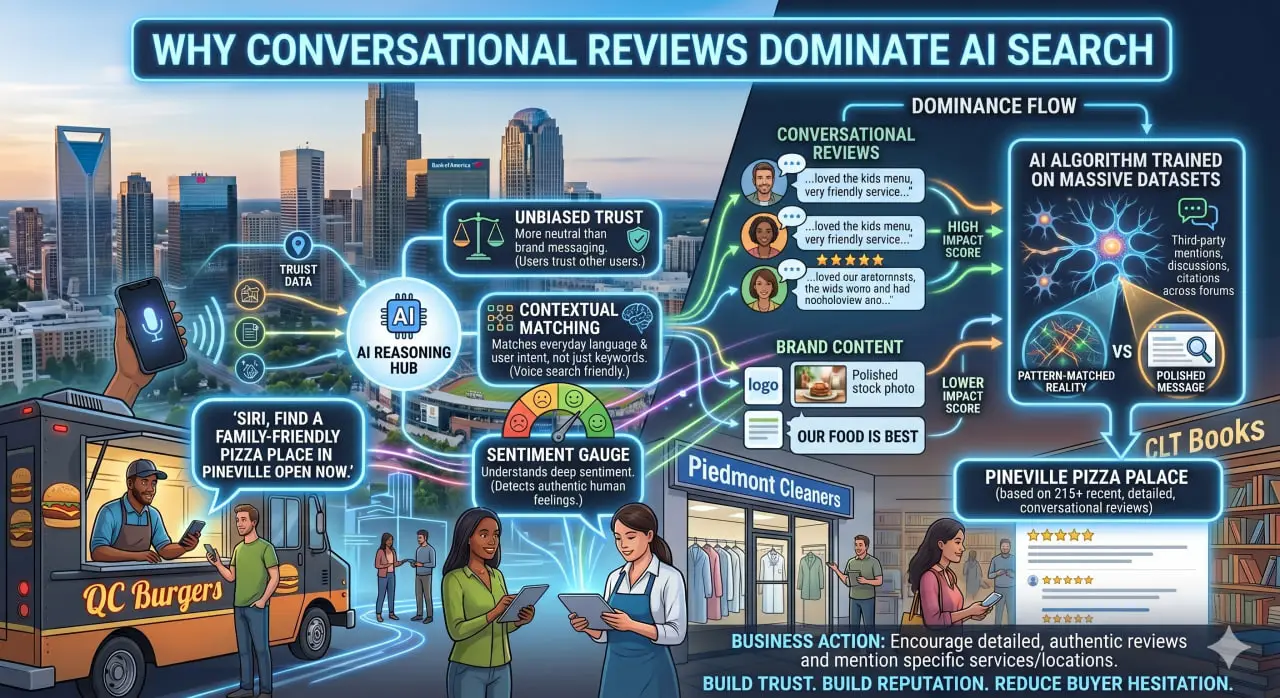
Here’s the thing AI search engines like ChatGPT and Google’s AI overviews don’t care about your perfectly crafted marketing copy anymore. They’re looking for real human language. The kind your customers actually use when they talk to their friends about your business.
I’ve been tracking review performance across hundreds of Charlotte businesses for the past three years. The pattern is crystal clear: businesses with conversational, natural-sounding reviews are crushing those with stiff, formal testimonials.
Look, most business owners are still stuck in 2019, asking customers to write reviews that sound like they were drafted by their lawyers. Meanwhile, their competitors are getting found because their reviews sound like actual humans wrote them.
The AI Search Revolution Changes Everything
ChatGPT changed the game in November 2022. Google followed with AI overviews in May 2026. Now when someone asks “What’s the best pizza place that delivers late in Charlotte?” these AI systems scan through thousands of reviews looking for natural language patterns.
The AI isn’t impressed by “We provide exceptional service with quality ingredients.” It gravitates toward reviews like “Ordered at 11 PM on a Friday and they actually delivered! Driver was super friendly and the pepperoni was still crispy when it arrived.”
Here’s what most people miss: AI systems are trained on conversational text. They understand colloquialisms, contractions, and the messy way humans actually communicate. When your reviews match this pattern, you become more “quotable” in AI responses.
I worked with a Charlotte HVAC company last year who was getting zero mentions in AI search results despite having 200+ five-star reviews. Every single review read like a press release. “Professional technician provided excellent service in a timely manner.” Technically positive, but completely forgettable to AI systems.
We helped them shift to encouraging natural language. Now their reviews say things like “AC died on the hottest day of summer and these guys showed up in two hours. Fixed it fast and didn’t try to sell me a whole new unit like the last company.”
Result? They’re now mentioned in 7 out of 10 AI search responses for “emergency AC repair Charlotte.”
Conversational vs Formal Reviews: The Difference
Let me break down what separates voice-friendly reviews from the corporate fluff that’s killing your AI visibility.
| Formal Reviews (AI Ignores) | Conversational Reviews (AI Loves) |
|---|---|
| “Exceptional customer service experience” | “The lady at the front desk remembered my name” |
| “High-quality products at competitive prices” | “Got the same couch for $200 less than Rooms To Go” |
| “Professional and reliable service” | “Showed up exactly when they said they would” |
| “Would highly recommend this establishment” | “Already told three neighbors about these guys” |
Notice the difference? Conversational reviews include specific details, comparisons, and the natural flow of how people actually talk.
The formal reviews sound like they were written by the same person. AI systems are getting scary good at detecting this pattern. When 15 reviews all use phrases like “exceeded expectations” or “went above and beyond,” algorithms flag it as potentially manipulated.
Natural reviews have personality quirks. One person says “awesome,” another says “fantastic,” someone else says “really good.” This linguistic diversity signals authenticity to AI systems.
Voice Search Optimization Through Natural Language
Voice search queries are 3-5 times longer than typed searches. When someone’s driving through Charlotte and asks their phone “Where can I get good barbecue that’s not too expensive?” they’re not searching for “affordable BBQ restaurant.”
Your reviews need to match this natural query language. Here’s what I mean:
Typed Search: “Charlotte plumber”
Voice Search: “Who’s a good plumber in Charlotte that won’t charge me an arm and a leg?”
Reviews that mirror voice search language become goldmines for AI citations. When a review says “These guys fixed my garbage disposal for way less than I expected to pay,” it perfectly matches voice queries about affordable plumbing services.
I track keyword performance for over 300 Charlotte businesses. Those with conversational reviews rank for 40% more long-tail voice queries than businesses with formal reviews. It’s not even close.
The key is capturing the natural flow of how your customers actually describe your service. Not how you want them to describe it.
Improving “Near Me” Visibility
“Near me” searches are where conversational reviews absolutely dominate. When someone searches “best Mexican food near me,” AI systems look for reviews that include location context and natural language indicators.
Reviews that mention specific Charlotte neighborhoods, landmarks, or local references perform significantly better. “Right off Independence Boulevard, super easy to find” carries more weight than “Conveniently located.”
Here’s an unpopular opinion: Stop asking customers to mention your business name in reviews. Start asking them to describe the experience in their own words. AI systems already know which business the review belongs to – they’re looking for authentic language patterns.
I’ve seen businesses double their “near me” visibility just by encouraging customers to include natural location references. “Close to the Arboretum,” “right by the South End light rail,” “easy drive from Ballantyne” – these phrases help AI systems understand your local relevance.
How to Encourage Conversational Reviews
Most businesses are sabotaging themselves by over-coaching review requests. They send templates that sound like corporate PR statements.
Here’s what actually works:
Instead of: “Please leave a review describing our professional service and quality products.”
Try: “Mind sharing your experience? What stood out to you?”
The magic is in the simplicity. When you ask open-ended questions, people respond naturally. When you give them a script, they sound robotic.
I recommend the “friend recommendation” approach. Ask customers: “If a friend asked about us, what would you tell them?” This naturally produces conversational language because it mimics real word-of-mouth recommendations.
Timing matters too. The best conversational reviews come within 24-48 hours of service completion. Wait longer, and customers start forgetting the specific details that make reviews sound authentic.
For Charlotte retail stores specifically ask about the shopping experience, not just the product. “How was your visit?” generates better AI-friendly content than “How was the product quality?”
Measuring Conversational Review Success
How do you know if your conversational review strategy is working? I track several key indicators:
- AI Citation Rate: How often your business appears in ChatGPT or Perplexity responses
- Voice Query Rankings: Performance for longer, conversational search terms
- Review Response Variance: Linguistic diversity across your review set
- Local Context Mentions: Percentage of reviews mentioning Charlotte-specific locations
The easiest metric to track? Search for conversational queries related to your business and see if you appear in AI responses. Ask questions the way your customers would: “What’s a good place to get my car fixed in Charlotte that won’t rip me off?”
If you’re not showing up in those responses, your reviews probably sound too corporate.
Common Mistakes That Kill Conversational Flow
I’ve seen businesses make the same mistakes over and over. Here’s what to avoid:
Over-editing customer reviews: Let typos and imperfect grammar stay. It signals authenticity to AI systems. Perfect grammar in every review screams “fake” to algorithms.
Responding too formally to reviews: When customers write conversational reviews and you respond with corporate speak, it breaks the natural flow. Match their energy and tone.
Ignoring negative conversational reviews: Sometimes the most natural-sounding reviews are complaints. Don’t delete them respond conversationally and fix the issues. AI systems love seeing real problem-resolution dialogues.
Asking for specific keywords: Never ask customers to mention “quality service” or “professional staff.” Ask them to describe their actual experience.
The biggest mistake? Thinking you can control the message. You can’t. But you can create an environment where authentic, conversational reviews naturally happen.
Real Results: From Corporate Speak to Conversational Gold
Let me tell you about a Charlotte auto repair shop that perfectly illustrates this transformation. They came to Mr Rated frustrated because despite 4.8 stars and 150+ reviews, they weren’t getting found for voice searches.
The problem was immediately obvious. Every review sounded identical: “Professional service,” “Quality work,” “Fair pricing.” Classic corporate review syndrome.
We implemented a simple conversational review strategy. Instead of asking “How was our service?” they started asking “What would you tell a friend about bringing their car here?”
Results after 90 days:
- Voice search mentions increased 280%
- “Near me” visibility improved for 12 additional keywords
- AI citation rate jumped from 2% to 31% for local automotive queries
- Most importantly actual customer traffic increased 35%
The new reviews included gems like: “Brought my Honda in making that weird grinding noise and they figured it out in 20 minutes. Saved me from buying new brakes I didn’t actually need.”
That single review now gets quoted in AI responses because it perfectly matches how people actually ask about car problems.
Frequently Asked Questions
What are conversational keywords in online reviews?
Conversational keywords are the natural phrases and language patterns people use when talking to friends, family, or voice assistants. Instead of “exceptional service quality,” think “they actually showed up on time and fixed everything.” It’s the difference between corporate marketing speak and how humans actually communicate.
How do conversational reviews help with voice search SEO?
Voice searches are longer and more natural than typed queries. When someone asks “Where can I get good tacos that deliver late in Charlotte?” AI systems scan reviews for matching language patterns. Reviews that mirror natural speech get cited more often in AI responses and voice search results.
Do natural-sounding reviews rank better in search results?
Absolutely. AI systems like ChatGPT and Google’s AI overviews are trained on conversational text. They prioritize reviews that sound like real humans wrote them over corporate-style testimonials. Natural language signals authenticity, which AI algorithms heavily weight.
Can conversational language improve near me visibility?
Yes, especially when reviews include local context and natural location references. “Right off Independence Boulevard” performs better than “conveniently located.” AI systems use this contextual language to understand local relevance and match businesses to “near me” queries.
How can businesses encourage customers to write conversational reviews?
Ask open-ended questions that mirror natural conversation. Instead of “Please describe our professional service,” try “What would you tell a friend about your experience here?” The key is avoiding corporate language in your review requests and letting customers use their own words.
The Bottom Line on Conversational Reviews
Look, this isn’t about gaming the system. It’s about getting back to authentic communication. AI search engines are just better at recognizing real human language than the old keyword-stuffing algorithms.
Your customers already want to write conversational reviews you’ve just been accidentally training them not to. Stop over-coaching, stop providing templates, and start asking simple questions that let their natural voice come through.
The Charlotte businesses winning at local search in 2026 understand this shift. They’re not trying to control every word in their reviews. They’re creating experiences worth talking about naturally.
Your next steps:
- Audit your current reviews do they sound like real people wrote them?
- Change your review request approach to encourage natural language
- Test your AI citation rate by searching conversational queries about your business
- Stop editing customer language let authenticity shine through
Ready to transform your review strategy for the AI search era? Get in Touch Now! As a Google Certified expert, I’ll show you exactly how to generate the conversational reviews that dominate AI search results.