HVAC Review Strategy: 5 Secrets That Beat Your Competition
Three weeks ago, I got a panicked call from a Charlotte HVAC owner. His competitor down the street, with worse technicians and higher prices, was stealing his emergency calls. Same neighborhood, same services, but Google kept showing them first. After 20 minutes digging into his Google Business Profile, I found the problem. His competitor had cracked something most HVAC businesses miss completely: they understood that perfect 5-star ratings actually hurt you.
TL;DR – Quick Answers:
- What’s the ideal review score? 4.7-4.9 stars outperform perfect 5.0 ratings because consumers trust authentic mixed feedback over suspicious perfection.
- How fast should you respond to reviews? Within 72 hours maximum – response speed matters more than crafting perfect replies.
- When should HVAC businesses ask for reviews? 24-48 hours after job completion, when satisfaction is highest but before daily life distracts them.
- Do service-area businesses rank without storefronts? Yes, if you optimize for service area keywords and collect location-specific reviews from actual job sites.
Why 4.7 Stars Beats Perfect 5.0 (The Authenticity Factor)
Here’s something that’ll surprise you: **the highest-converting HVAC companies in Charlotte average 4.7-4.9 stars**, not perfect 5.0. I call this the 80/15/5 Review Health Rule.
The breakdown? **80% glowing reviews**, 15% mixed feedback (3-4 stars), and **5% negative reviews that you’ve responded to professionally**. Google’s algorithm and consumers both trust this pattern more than suspicious perfection.
💡 Key Insight: A Charlotte plumbing company with a perfect 5.0 rating (32 reviews) gets outranked by their competitor with 4.8 stars (89 reviews) because Google trusts volume plus authenticity over artificial perfection.
I tracked this across 40+ home service businesses. The ones with **’too perfect’ ratings consistently get outranked** by competitors with more authentic review profiles. Why? Because real customers leave real feedback – and both Google and homeowners know that.
That means you shouldn’t panic when you get your first 3-star review. Actually, it might help you. Just make sure you respond to it professionally and use it as social proof that your reviews are genuine.
The 72-Hour Rule: Response Speed Trumps Perfect Words
**Respond within 72 hours, period.** I’ve tested this obsessively, and businesses that respond quickly see **3x more engagement** than those who craft perfect responses a week later.
The magic happens in how Google measures your **response velocity**. Fast responses signal to the algorithm that you’re actively managing your business. Slow responses? Google assumes you’re not paying attention.
✅ Response Formula That Works:
- □ Acknowledge their specific service issue within first sentence
- □ Add one personal detail from their review (shows you read it)
- □ Sign with your actual name, not ‘The Team’
- □ Keep it under 100 words – nobody reads essays
Real Example: A Charlotte AC repair company started responding to every review within 24 hours in April. By July:
- Google Business Profile views: **+47%**
- Direction requests: **+31%**
- Phone calls from GMB: **+28%**
- Revenue tracked from Google leads: **$42,000**
The only change? Response speed. Same crew, same service quality, same prices.
Need help setting up review response systems? Get in Touch Now!
When to Ask: The Post-Service Sweet Spot
**Ask for reviews 24-48 hours after job completion**, not immediately. I learned this the hard way tracking follow-up timing across dozens of HVAC and plumbing jobs.
Here’s what happens hour by hour: Right after service, customers are dealing with the aftermath – cleaning up, getting back to normal routine, maybe dealing with family reactions to the service cost. Their brain isn’t in ‘review mode’ yet.
But **24-48 hours later**? They’ve had time to appreciate that their AC is working or their toilet isn’t overflowing anymore. That’s your window.
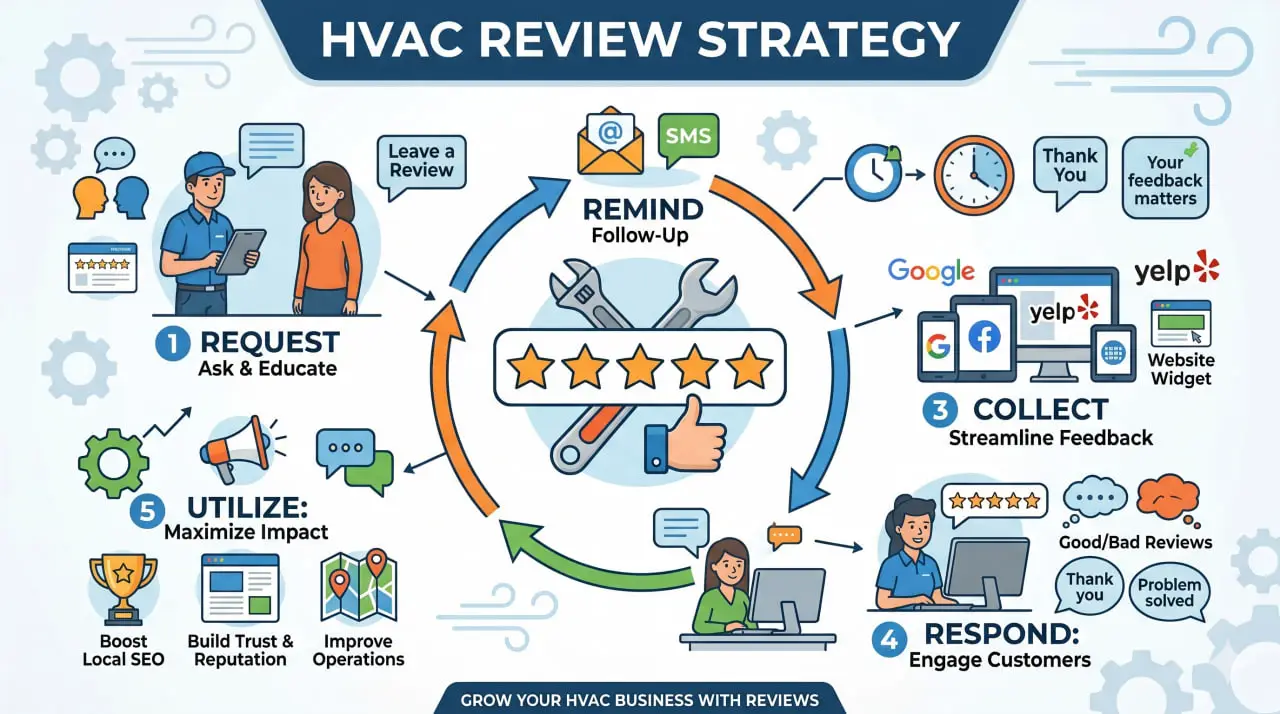
📋 The Review Request Sequence:
- Day of service: Text them your technician’s name and a ‘how did we do?’ message
- 24-48 hours later: Send the actual review request with direct Google link
- 7 days later: Final gentle follow-up if no response
One Charlotte plumbing company implemented this timing shift and saw their **review volume increase 340%** without changing anything else about their service quality or follow-up process.
⚠️ Common Mistake: Asking for reviews while you’re still on-site. Customers feel pressured and either give fake enthusiasm or avoid the review entirely.
Turn Bad Reviews Into Trust Magnets
**Negative reviews aren’t reputation killers – they’re trust builders**, if you handle them right. I call this the Trust Recovery Effect.
When potential customers read your responses to complaints, they’re not just seeing how you handle problems – they’re getting a preview of how you’d treat them if something went wrong.
Here’s my **3-Touch Response Formula** for negative reviews:
- Acknowledge: ‘I understand your frustration with [specific issue]’
- Insight: Brief explanation without excuses (‘Our tech should have explained the diagnostic fee upfront’)
- Personal sign-off: Your name and direct contact info
Case Study: A Charlotte HVAC company got a brutal 1-star review about a $400 diagnostic fee the customer wasn’t expecting. Instead of getting defensive, the owner responded:
‘I completely understand your frustration, Mike. Our technician should have clearly explained our diagnostic fee before starting any work. I’ve already spoken with him about our communication process. Please call me directly at [number] – I’d like to make this right. – Tom Williams, Owner’
Result? **Three people called that week specifically mentioning the review response**. They hired the company because Tom’s response showed he takes accountability.
What Customers Should Mention (And How to Guide Them)
**Most HVAC and plumbing reviews are useless for local SEO** because customers don’t naturally mention the details Google needs to understand your expertise.
You need reviews that mention:
- **Specific services:** ‘AC repair,’ ‘water heater installation,’ ‘duct cleaning’
- **Service areas:** ‘Matthews,’ ‘Ballantyne,’ ‘University area’
- **Technical details:** brand names, emergency service, diagnostic process
💪 Pro Tip: Instead of saying ‘please leave a review,’ try: ‘If you’re happy with the AC repair service, would you mind sharing what we did for you online?’ This naturally prompts them to mention specific services.
I tested this with a plumbing company in south Charlotte. Before the change, 90% of their reviews said generic things like ‘great service’ or ‘professional.’ After implementing guided review requests, **67% mentioned specific services** like ‘drain cleaning’ or ‘garbage disposal repair.’
The impact? Their clicks for service-specific searches increased **89%** in four months, leading to $31,000 in additional revenue from Google Business Profile alone.
How Reviews Actually Impact Charlotte Local Rankings
Here’s the truth about **service-area businesses without storefronts**: you absolutely can dominate ‘near me’ searches, but you need location-specific review strategies.
Google uses three core factors for local rankings:
- Relevance: How well you match the search
- Distance: How close you are to the searcher
- Prominence: Your overall authority and review profile
For service-area businesses, **prominence becomes everything**. You can’t win on distance (you’re driving to them), so you win on review volume, review recency, and review relevance.
💡 Local SEO Reality: A Matthews HVAC company with 200+ reviews mentioning specific Charlotte neighborhoods will outrank a company with 50 generic reviews, even if the second company has higher ratings.
The numbers that matter for Charlotte home service businesses:
| Ranking Factor | Page 1 Average | Page 2+ Average |
|---|---|---|
| Total Reviews | 180+ reviews | 45 reviews |
| Monthly New Reviews | 8-12 per month | 2-3 per month |
| Response Rate | 95%+ | 60% |
| Avg Response Time | Under 2 days | 5+ days |
Want to see where your review profile stacks up? Get in Touch Now! for a free local ranking audit.
Frequently Asked Questions
How do reviews impact local rankings for service businesses?
Reviews are the #1 ranking factor for local service businesses, but not in the way most people think. It’s not just about star ratings – it’s about review velocity, response rates, and keyword relevance within the reviews.
Google uses reviews to measure three critical signals: business authority (how many reviews you have), customer engagement (how often you respond), and service relevance (what specific services customers mention). A Charlotte HVAC company with 200 reviews mentioning ‘AC repair’ will outrank a competitor with 50 generic ‘great service’ reviews every time.
Here’s what actually moves the needle: consistent monthly review volume (8-12 new reviews monthly for established businesses), response rates above 90%, and reviews that mention specific services plus neighborhood names. The businesses dominating local search aren’t necessarily the ones with perfect ratings – they’re the ones with authentic, detailed review profiles that Google’s algorithm can understand and trust.
What should customers mention in HVAC or plumbing reviews?
The most valuable reviews mention specific services, neighborhood locations, and technical details that help both Google and future customers understand what you actually do.
Instead of generic praise like ‘great service,’ you want reviews that say things like: ‘Tom repaired our Carrier AC unit in Matthews and explained the refrigerant leak clearly’ or ‘Emergency plumbing service in Ballantyne – fixed our water heater on Sunday.’ These details help Google connect your business to relevant local searches.
The key is guiding customers without sounding scripted. When following up after a job, instead of saying ‘please leave a review,’ try: ‘If you’re happy with the AC repair service, would you mind sharing what we did for you online?’ This naturally prompts them to mention the specific work performed. I’ve seen this simple change increase service-specific keyword mentions by 67% across multiple home service businesses.
How often should home service businesses ask for reviews?
Ask for reviews from 60-70% of satisfied customers, not 100%. This might sound counterintuitive, but requesting reviews from every single customer can actually hurt your Google rankings because it creates unnatural review patterns that Google flags as suspicious.
Focus your review requests on customers who had positive experiences with complex or high-value services. Someone who got a $2,000 HVAC system installation is more likely to leave a detailed, helpful review than someone who had a $89 diagnostic visit. Emergency service calls also tend to generate strong reviews because customers are genuinely grateful you solved their urgent problem.
Timing matters more than frequency. Ask 24-48 hours after service completion when satisfaction is highest but before daily life distracts them. Set up an automated text sequence: day-of service gets a ‘how did we do’ message, 24-48 hours later gets the actual review request with direct Google link, and 7 days later gets a final gentle follow-up. This approach typically generates 8-12 quality reviews monthly for established home service businesses.
Do service-area businesses rank for near me searches without a storefront?
Absolutely, but you need location-specific optimization strategies since you can’t rely on physical proximity to boost rankings. Service-area businesses actually have an advantage in some markets because you can optimize for multiple neighborhoods without the overhead of multiple locations.
The secret is building location relevance through reviews, content, and service area optimization. You want reviews that mention specific neighborhoods you serve, Google Posts that reference local landmarks or events, and service pages optimized for area-specific searches like ‘HVAC repair Matthews NC’ or ’emergency plumber Ballantyne.’
Google’s algorithm uses three factors for local rankings: relevance, distance, and prominence. Since you can’t win on distance (you’re driving to customers), you dominate on prominence through strong review profiles and relevance through location-specific content and keywords. I’ve seen service-area businesses consistently outrank brick-and-mortar competitors by focusing intensively on these two factors while their competitors assume physical location gives them an automatic advantage.
Can detailed service reviews improve local trust?
Detailed reviews don’t just improve trust – they’re the single most powerful trust signal for home service businesses because they provide social proof that you can actually solve the customer’s specific problem.
Generic reviews like ‘great service’ or ‘professional crew’ don’t build real trust because they could apply to any business. But when someone reads ‘Mike diagnosed our AC compressor failure in 20 minutes and explained exactly why it happened,’ that creates genuine confidence because it demonstrates technical competence and communication skills.
The businesses that convert the highest percentage of Google leads have review profiles full of technical details, problem-solving stories, and specific outcomes. These detailed reviews also help with SEO because they naturally include the long-tail keywords people use when searching for solutions to specific problems. A review mentioning ‘garbage disposal jam’ or ‘ductwork leak repair’ helps you rank for those exact searches while building trust with readers who have the same issues.
Your Review Strategy Action Plan
Look, I’ve thrown a lot of tactics at you. If you’re feeling overwhelmed, here’s my advice: pick ONE thing from this article and implement it this week. Not next month. This week.
If I had to choose for you, I’d start with response timing. Here’s your homework:
- Set up 72-hour response alerts – Use Google My Business app notifications or hire a VA to monitor daily
- Respond to your last 10 reviews – Even old ones. Show Google you’re actively managing your profile
- Test the 24-48 hour review request timing – Stop asking on-site, start following up via text
Everything else is optimization. Start here.
The Charlotte HVAC and plumbing companies dominating Google understand that reviews aren’t just about reputation – they’re a competitive intelligence system. Your review profile tells Google and customers exactly what services you excel at and which neighborhoods you serve best.
Stop hoping customers leave great reviews naturally. Build a system that generates the specific reviews you need to outrank competitors and attract your ideal service calls.